
The fajas of the Pyrenees are among the most spectacular hiking routes in these mountains. These trails follow narrow natural ledges halfway up the mountainsides, creating a balcony-like path beneath towering rock faces.
Generally situated at altitudes of between 1,500 and 2,500 metres, they allow hikers to walk along the mountain slopes and enjoy panoramic views of deep valleys and the peaks of the Pyrenees.
Originally used as paths by shepherds and hunters, these routes now offer a wonderful way to experience the natural beauty of the Pyrenees. They are an ideal destination for hiking enthusiasts and nature lovers seeking to discover the mountains in all their alpine splendour.

The Faja de las Flores offers a spectacular way to experience Ordesa from above. It is one of the most extraordinary balcony trails in the Pyrenees, renowned for its breathtaking panoramas and unique route.
At around 2,400 metres, this trail in Ordesa and Monte Perdido National Park follows a natural ledge high above the Ordesa Valley. The rock terrace stretches for approximately three kilometres along immense limestone walls, offering views of the valley and the surrounding peaks.

Looking for a spectacular circular hike through the heart of the Ordesa Valley?
This is a route worth adding to your list! The ascent along the Senda de los Cazadores (Hunters’ Trail) will put your legs to the test with a steep climb to our first viewpoint, overlooking the Cotatuero Cirque, a natural amphitheatre carved into the mountains.
From there, we’ll follow the Faja de Pelay, a natural ledge winding high above the valley beneath towering limestone cliffs. This spectacular balcony trail offers panoramic views of the Ordesa Valley and its surrounding peaks before leading us to the Cola de Caballo waterfall.
For the return journey, we’ll follow the valley floor, passing through enchanting beech forests and alongside the waterfalls of the Arazas River.
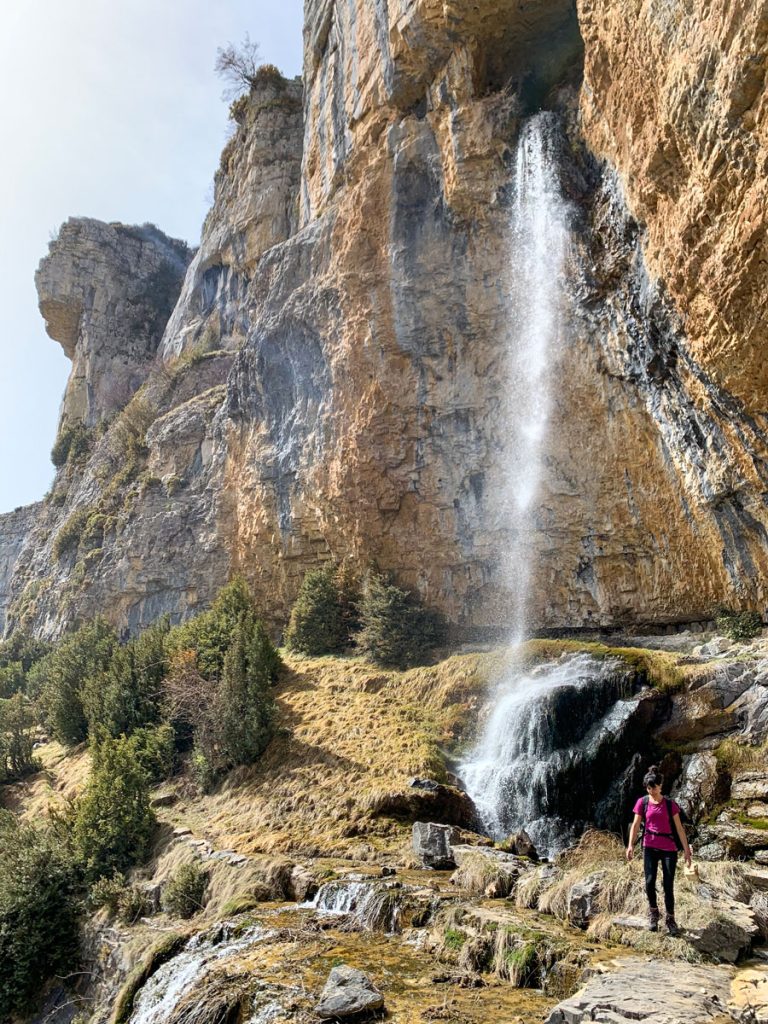
Already explored the famous mountain ledges of Ordesa and looking for a quieter trail off the beaten path? The Faja de las Pardinas is a lesser-known route that rewards hikers with a bird’s-eye view into the depths of the Añisclo Canyon.
We start in the mountain village of Nerín and make our way towards Cuello Arenas. The climb takes some effort, but the reward is well worth it: far-reaching views of the majestic peaks of Ordesa and Monte Perdido National Park.
Along the way, we’ll admire the rock walls plunging into the deep canyon below. With a little luck, we may spot griffon vultures, bearded vultures and golden eagles soaring above the mountains.
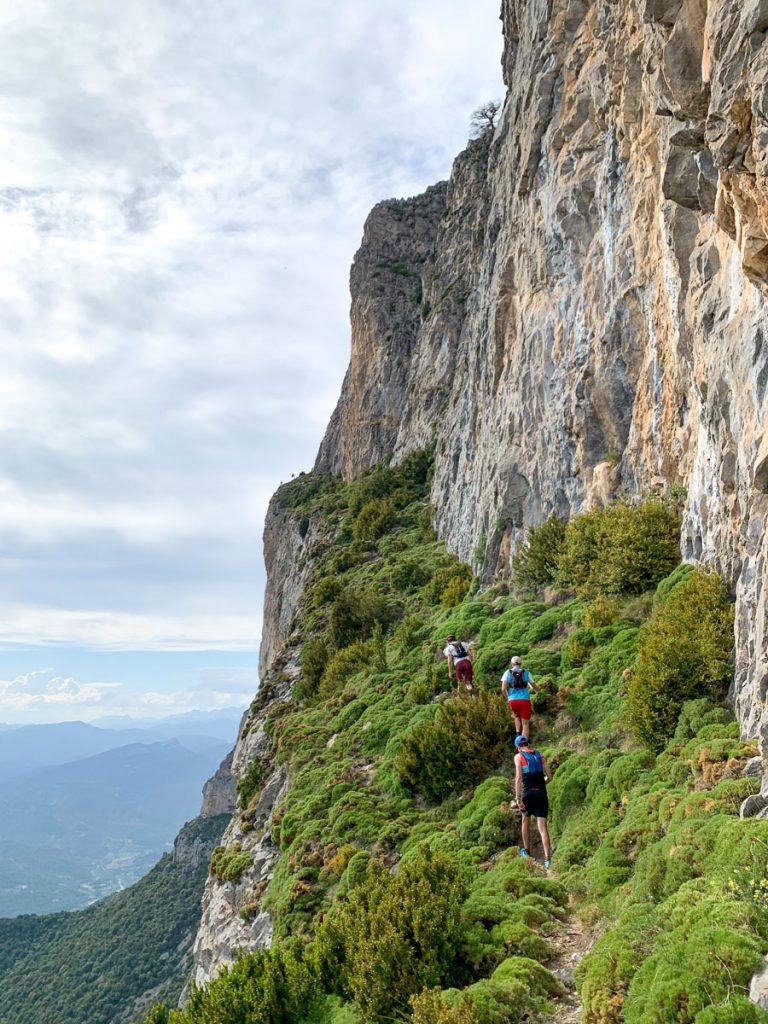
Peña Montañesa holds a special place in our hearts and is an iconic part of the landscape surrounding Aínsa. Although it doesn’t reach 3,000 metres, the climb to its summit involves a considerable elevation gain, making it a rewarding hike if you’re staying in the valley.
There are several ways to reach the summit, but one of our favourites is the route via the Faja Toro. This narrow trail traverses the mountain’s rocky walls, offering magnificent views across the Sobrarbe region. Although it doesn’t involve any major technical difficulties, the route is exposed in places, so sure-footedness and a good head for heights are essential.
For an extra dose of adventure, you can finish the descent with a 30-metre abseil.

Step off the beaten path and discover a different side of the Ordesa Valley on this circular hike.
The Faja Racón is a 3 km trail following a natural ledge along the mountainside beneath the Gallinero rock face, with views across the Ordesa Valley and towards the towering peak of Tozal del Mallo. The Faja Canarellos offers another 3 km of hiking beneath the rocky slopes of La Fraucata.
To finish, we descend through a beech forest to the valley floor, where the Arazas River and its cascading waterfalls await.

The Faja Tormosa (Feixa Tormosa) offers a privileged viewpoint over the Pineta Valley, allowing us to admire its full length from above. From these heights, we can appreciate the valley’s distinctive shape and traces of its glacial origins, visible in its slopes and rock faces.
The route combines beech forests, mountain trails and waterfalls, with the Cinca waterfall being one of its main highlights.
It’s an ideal hike from spring through autumn. In fall, the beech forests changes into a colourful autumn spectacle, transforming the landscape.

A circular route through the Barrosa Valley, where nature and history come together.
The route takes us to the old Liena mines, a reminder of the mining activity that shaped this part of the Pyrenees for decades, and of the challenges involved in transporting ore across the mountain range between Spain and France.
After reaching Punta Liena (2,600 m), we continue along the path of ‘las Pardas’, a narrow, exposed mountain ledge that follows the rock walls of the Barrosa Cirque. Some of the more challenging sections are equipped with chains.
The route continues to the Barrosa mountain pass, a historic crossing between Spain and France. From here, we descend through the valley to return to our starting point.
Fajas were originally traditional mountain paths used by shepherds and livestock farmers. They used these paths to travel between different valleys and move their animals from one place to another.
Most fajas run along the rocky walls of the Pyrenees. Over time, natural processes have shaped narrow strips of land along the mountainsides or created gaps and hollows in the rock that can be used as paths.
Geography and Rock Formations
The Pyrenees have a rugged, steep landscape, so many fajas cross rocky terrain, cliffs and vertical limestone walls. The fajas are not paths built by people. Instead, many follow natural ledges and gaps in the rock that have been shaped by erosion over thousands of years.
The Pyrenees are home to a wide variety of wildlife. Hiking on these mountain ledges, you may spot some of the region’s most iconic birds, such as griffon vultures and kites.
Mammals such as marmots, roe deer and red deer are also commonly found in the nearby valleys. In more remote areas, you may even spot a chamois, a sure-footed mountain animal adapted to life at high altitudes.
The fajas of the Pyrenees offer a different way to experience the mountains, following mountain ledges at higher altitudes. These routes require planning, navigation and the ability to assess the terrain. Our guides know the terrain well and make safety a priority.
A guided hike also means you can enjoy the experience without having to worry about the planning and logistics:
Prices per person for a group of 4. Get in touch for other group sizes and options.
– Certified guide
– Public liability and accident insurance
– Technical materials
– Transport
– Food
– Personal equipment
A reasonable level of fitness, with no injuries, conditions or illnesses that could prevent you from walking comfortably on tracks and trails with varying gradients.
Hiking boots, a windproof and waterproof jacket, a cap, sunglasses and sunscreen, a 20-litre backpack, water and picnic. In colder periods: suitable warm clothing, gloves and a warm hat.

